Benchmarking Carbon Calculation within UK Veterinary Practice
Between May and September 2025, Vet Sustain led a benchmarking study to support 19 farm and mixed practices (BCVA or XLVets members) in calculating their carbon footprint using the Vet Sustain ‘Veterinary Carbon Calculator’ tool. Megan Williamson, Resource Development Manager at VetSalus and member of Vet Sustain’s Food and Farming Working Group, presenting results of the study at BCVA’s Annual Congress in October 2025. Read on to find out more about this project.
Megan Williamson
Climate change is already impacting animal health and is widely recognised as the greatest public health threat of the 21st century. Vets and the wider vet-led team have a dual responsibility: to address these health impacts, whilst also reducing the environmental footprint of their care. To avoid exceeding 1.5°C warming, we need to reach Net Zero emissions by 2050.
Vets are uniquely positioned to provide leadership on climate action due to their scientific expertise, public trust, and focus on animal health. Farm vets in particular sit right at the heart of animal, human and environmental health, and with a One Health approach can make a huge contribution in the race to Net Zero.
We are already seeing a transition to more environmentally conscious business practices across many sectors. The veterinary sector, like human healthcare, contributes to global emissions and must transition toward more sustainable practices.Veterinary students and professionals are increasingly aware of this issue, want action, and are willing to support practices that prioritise them (Koytcheva et al., 2021). Surveys also tell us that clients value sustainable practices (Deluty et al., 2021), and veterinary professionals express strong interest in learning how to reduce their environmental impact and want better access to guidance (Higham et al., 2023).
Between May and September 2025, Vet Sustain led a benchmarking study to support 19 farm and mixed practices (BCVA or XLVets members) in calculating their carbon footprint using their ‘Veterinary Carbon Calculator’ tool. Practices were supported through the project through webinars and a peer-to-peer WhatsApp group, and received personalised benchmarked results alongside bespoke support to target their emissions hotspots. Vet Sustain worked in partnership with Investors in the Environment, who provided expert guidance, and received favourable ethical approval and support with data analysis from University of Surrey.
Results
Whilst there were only 19 practices involved within the study, there were a number of interesting trends observed during data analysis (with no statistical significance). It is standard practice in carbon accounting to calculate emissions per Full Time Equivalent Employee (FTE-E), and we noticed a correlation between the number of employees and the total carbon footprint of the practice, measured in carbon dioxide equivalent (CO2e) (Figure 1). When studying a potential link between the clinical workload of the practice, as indicated by the number of veterinarians employed (Full Time Equivalent Vets - FTE-V), we observed a wide range of differences between CO2e per FTE-E and FTE-V (Figure 2). This could perhaps be attributed to the number of veterinary technicians and nurses employed by a practice, taking on a higher proportion of clinical workload.
Emissions from travel made up the largest proportion of all practice’s overall carbon footprint, although these varied widely across practices in the study. Some practices had already employed sustainable energy solutions, such as solar panels on practice buildings.
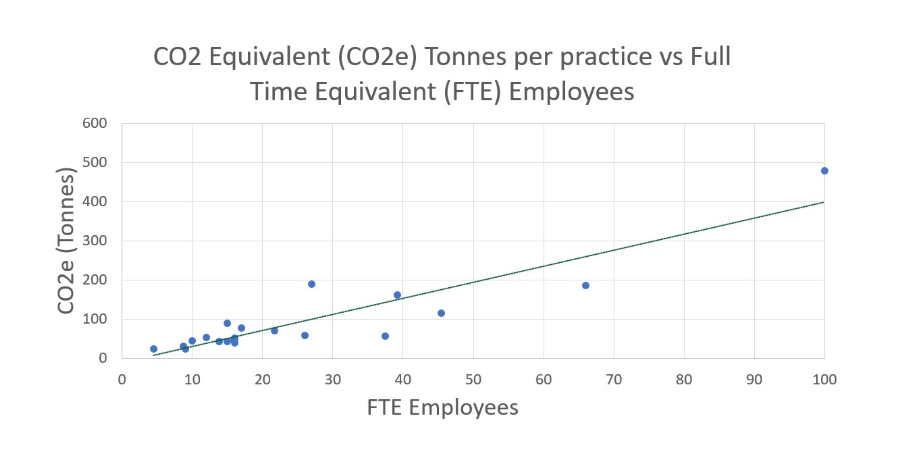
Figure 1: Correlation between number of full time equivalent (FTE) employees per practice and their total Carbon Footprint (CO2e) per practice.
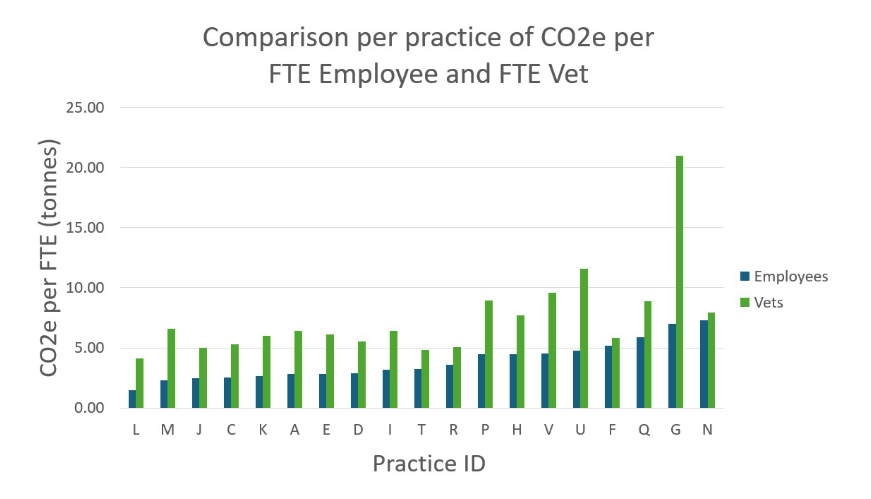
Figure 2: Comparing total CO2e per FTE Employee (FTE-E) and Per FTE Veterinarian (FTE-V). The average CO2e per FTE-E was 3.88 tonnes (Range 1.49 - 7.31 tonnes CO2e), average CO2e per FTE-V was 7.51 tonnes (Range 4.14 to 21.01 tonnes CO2e). Practices with a large difference between CO2e per FTE-E and FTE-V could be attributed to higher proportions of staff conducting clinical work, such as nurses and vet technicians.
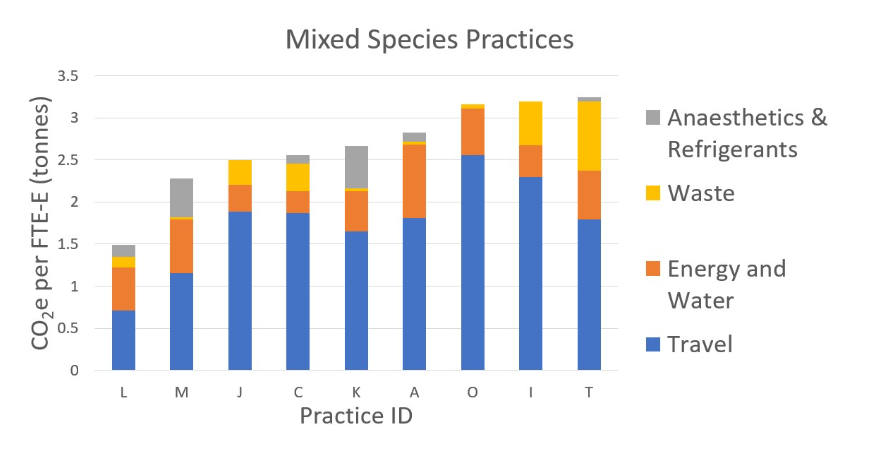
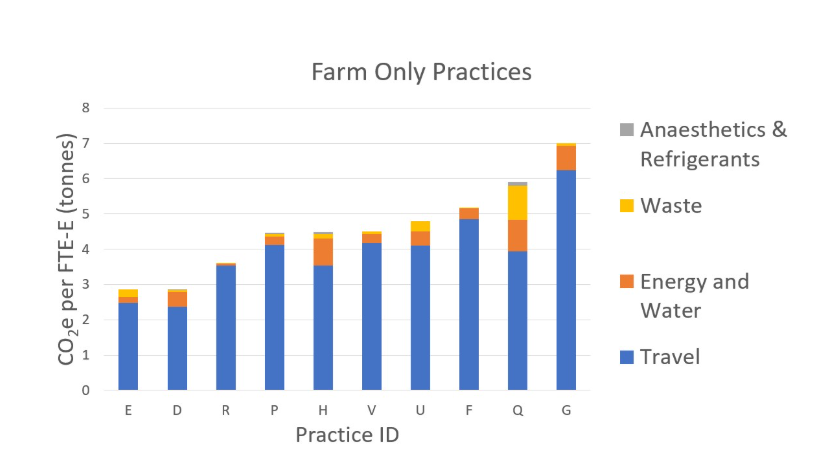
Figures 3a and 3b: CO2e emissions calculated by business function. There was greater variation between farm-only practices (defined as 95% or more farm-only clients) and mixed practices, which had some element of farm work.
Limitations of this Study
Although the data returned in this study is interesting and actionable, comparisons between farm and mixed practices are not appropriate due to the small sample size and differences in species coverage. The existing level of record keeping presented a challenge to all practices, and understanding the data collection requirements may have impacted participants’ ability to report accurately.
A large amount of the waste produced by farm veterinarians is disposed of on farm, therefore it is not easy to routinely measure by practices. Monitoring waste streams could also be difficult in shared business/home operations. The calculator tool does not factor in the carbon footprint of purchased goods and services (Scope 3), or staff and client commuting, which may also skew the data output.
Taking Action Against Climate Change
Whilst there were a number of limitations to this study, there are a number of key learnings. All practice could focus on improving the efficiency of ambulatory travel and investigate low carbon travel alternatives, such as use of electric vehicles. Other measures to consider include energy efficiency measures and employing lower carbon energy solutions, such as solar panels, building insulation and heat pumps etc.
Despite interest in sustainability from clients, vets and students, a value-action gap remains to be filled at practice level. Practice owners and managers are key to driving a shift towards more sustainable veterinary practices by aligning sustainability with business goals such as profitability, team purpose, and client value. Practices could focus on what is within their control as a starting point, and seek expert advice to support them through the process of carbon calculation and emissions reduction. Vet Sustain’s Veterinary Carbon Calculator is a good place to start.
Acknowledgements
This was a collaborative project delivered by Vet Sustain and University of Surrey. With thanks to BCVA and XLVets Communications Teams in signposting practices to the study, Laura Gelder-Robertson and Megan Williamson from Vet Sustain, Hannah Davies and Elizabeth Johnson of University of Surrey, David Knight from Investors in the Environment.
References
Deluty, S.B., Scott, D.M., Waugh, S.C., Martin, V.K., McCaw, K.A., Rupert, J.R., Webb, T.L., Baumgarn, S.A., Carpenter, M.J. and Duncan, C.G. (2021) Client Choice May Provide an Economic Incentive for Veterinary Practices to Invest in Sustainable Infrastructure and Climate Change Education. Front. Vet. Sci. 7:622199. doi: 10.3389/fvets.2020.622199.
Higham, L.E., Halfacree, Z.J., Stonehewer, J., Black, D.H., Ravetz, G., Moran, D., Boden, L. and Oxtoby, C. (2023) Sustainability policies and practices at veterinary centres in the UK and Republic of Ireland. Vet Rec. 2023;e2998. doi: 10.1002/vetr.2998
Koytcheva, M.K., Sauerwein, L.K., Webb, T.L., Baumgarn, S.A., Skeels, S.A., Duncan, C.G.. (2021) A Systematic Review of Environmental Sustainability in Veterinary Practice. Topics in Companion Animal Medicine: 44, pp. 100550, doi: 10.1016/j.tcam.2021.100550.