Rethinking Horse Management: Ellie Smith’s Regenerative Journey at Roots In at Ty Mawr, Raglan
When Ellie and Dan Smith took on Roots In at Ty Mawr, a 200-acre tenant farm near Raglan, Monmouth, they saw more than an area of degraded land, they saw a blank canvas. United by a shared commitment to climate-conscious farming, biodiversity and education, the couple set out to build a regenerative system which works with nature, not against it.
Vet Sustain
At the heart of the story is Ellie, and her horses. Ellie and Dan have taken a holistic approach to their farm management at Roots In, where the horses are fully integrated into their farming system.
From Therapy Horses to Regenerative Thinking
Ellie’s journey into farming wasn’t traditional. With a background in textile design and tailoring, she once worked far from fields and livestock. But her time at a farm on the Wales England border, for a charity engaging young people in farming, marked a turning point. There, she worked with horses in a therapeutic setting and began noticing something starkly different from the neighbouring yards; their system was developing into a more innovative way, guided by regenerative principles.
When Ellie and Dan later became parents, their perspective deepened. Their children’s curiosity about the planet and the future pushed them to reflect on how they farmed and why. They wanted to model something better and to be able to explain it.
Doing Horses Differently
Ellie believes it is widely accepted that horses are often managed within a traditional framework, with systems that are time-intensive and disconnected from ecological understanding. Taking a holistic view, she began asking why horses develop common health and behavioral issues and how much of that is linked to environment and management.
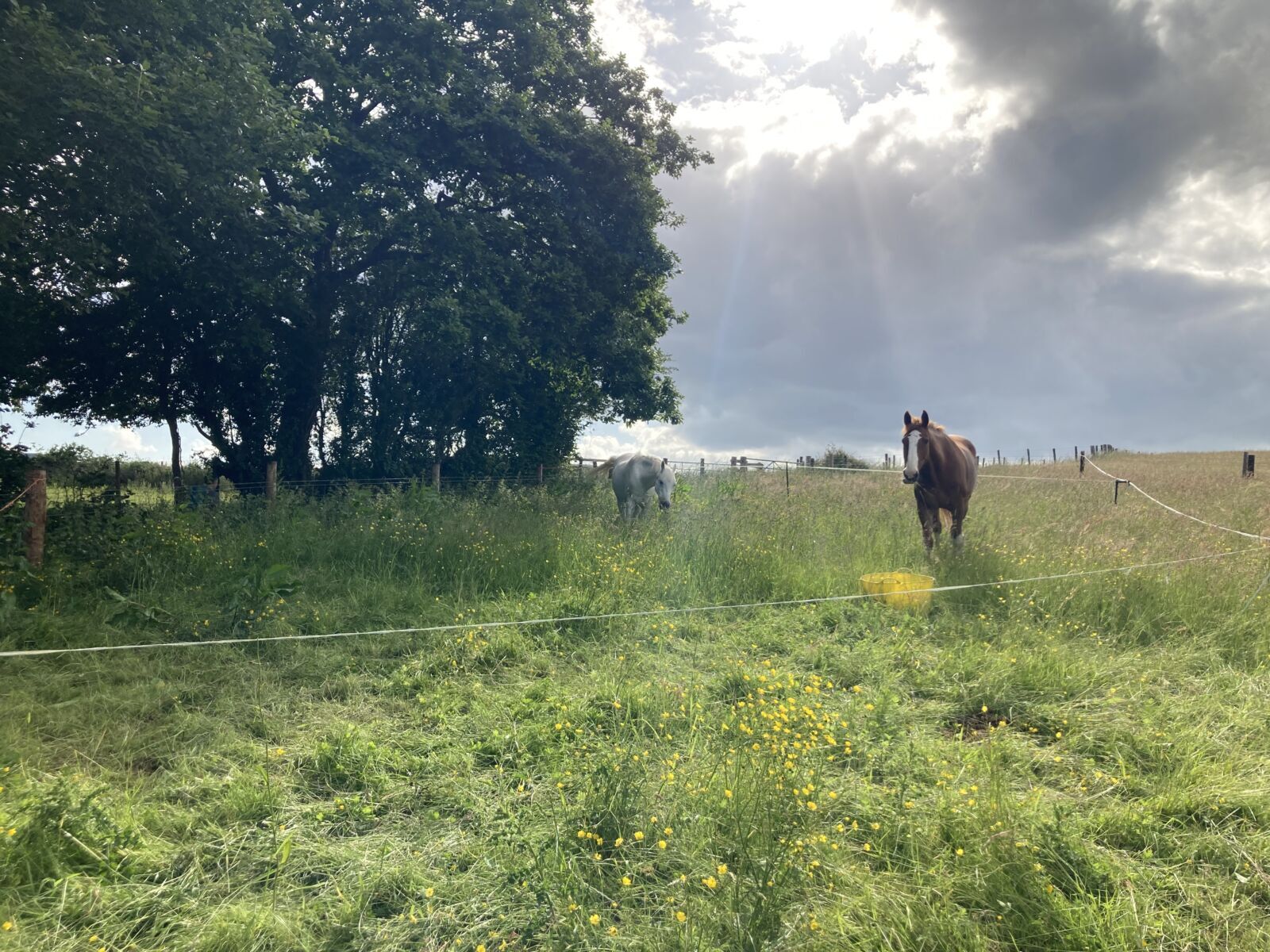
On their farm near Raglan, the couple have introduced adaptive multi-paddock grazing consisting of a grid grazing system for their two horses on two acres. Using straightforward electric fencing, they create grazing ‘cells’, moving the horses on daily or twice daily. Each cell then rests for a minimum of 45 days, allowing sward and soil to not only recover fully, but to have the opportunity to improve.
The results have been striking. The ground, once heavily poached in the wet, therefore compacted and slow to recover now bounces back quickly. After a year of the system, soil health and biodiversity have visibly improved. Ellie and Dan often perform visual evaluation of soil structure (VESS) tests to assess compaction and look for dung beetles and other indicators of life. They don’t overseed, spray, harrow or remove muck. The soil is allowed to function as it should, therefore manure breakdown is quick and efficient. Their paddocks are becoming more resilient, both to persistent wet and extreme drought. This management is promoting infiltration and water storage rather than runoff.
Chickens follow behind the horses, helping to break up manure and adding nutrients back into the soil. The system has eliminated the need for chain harrowing or any mechanical intervention, and, notably, they have avoided using antiparasitic treatments in their horses. In winter, hay is provided as needed, and during extreme weather, the horses can be taken off the land to avoid poaching. Horse behaviour is closely monitored, and management adapts if needed, whether that means adjusting herd dynamics or providing more space if additional or reduced grazing is needed.
Their horses have experienced very few health issues, reinforcing Ellie’s confidence in the critical role that the environment plays.
A Whole-Farm Regenerative Vision
The horses are just one part of a much bigger picture - the farm utilises 100 acres of arable for production currently sold to Wildfarmed, alongside 60 sheep, 20 Hereford cattle, chickens and the horses. Pollinator strips weave through large arable fields, reflecting their belief that diversity must underpin every decision.
They have currently established an acre of vegetables, an acre of cut flowers, a woodturner and bees, strengthening both ecological and community resilience.
Dan, who grew up on a traditional family farm and has worked in groundworks and farm management, has committed himself to “better farming.” After a ten year deep dive into grazing systems and regenerative practices, previously managing the farm in Redbrook he is now focusing on the tenancy on their own farm - Roots In at Ty Mawr.
Both Ellie and Dan also work off-farm in consultancy, bringing broader insight into land use, sustainability and holistic decision-making. They value mentoring, discussion and learning from others, and regularly welcome visitors to the farm, believing that shared perspectives accelerate progress. Two neighbouring farms on the same estate are also farming regeneratively, creating a growing community of practice.
Education at the Core
Education sits at the centre of everything they do. Ellie is passionate about giving children and adults the opportunity to see alternative systems in action, particularly when it comes to horses. The visual impact of healthy, biodiverse paddocks challenges assumptions about what equine management should look like.
Their mindset extends beyond farming practices. In general, they are a very low waste household, a reflection of their wider environmental commitment.
For Ellie and Dan, regeneration isn’t a technique; it’s a framework. Every decision aligns with their values: soil health, biodiversity, climate responsibility, community and future generations.
What began as a desire to keep animals less conventionally has evolved into something far greater, a living example of how thoughtful, holistic farming can restore land, nurture animals and inspire people.